What does an AI receptionist do for a contractor?
An AI receptionist is software that answers your business phone with a natural voice, 24/7. It greets callers, answers common questions, qualifies the job, and books the appointment or takes a message. For contractors it means you never miss a call while you are on a roof, under a sink, or driving between jobs.
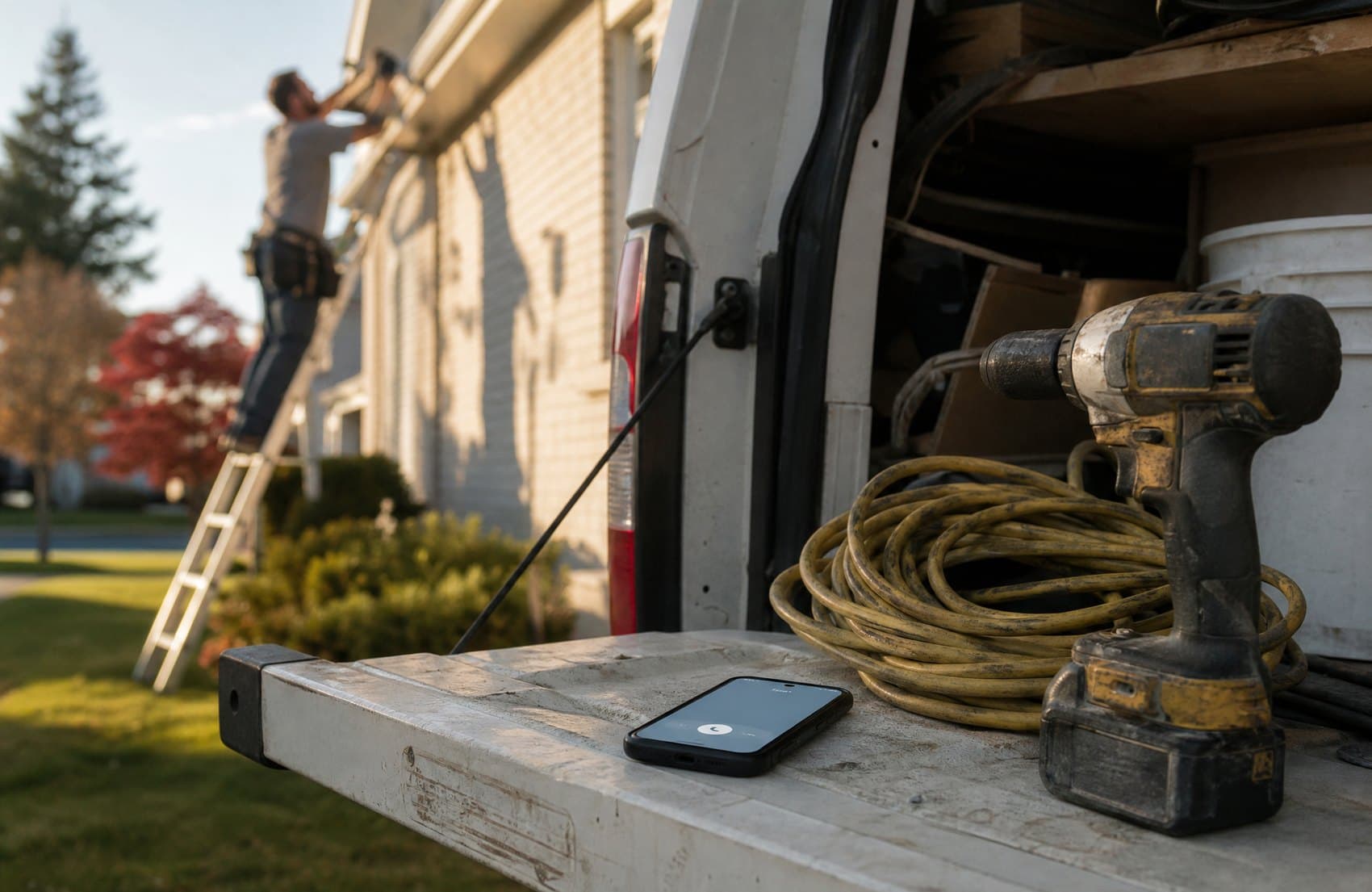
An AI receptionist answers your phone when you cannot, which for most contractors is most of the day. You are on a ladder, in a crawl space, or covered in drywall dust, and the phone keeps ringing. Every call that hits voicemail is a homeowner who calls the next roofer or electrician on their list. This guide explains exactly what an AI receptionist is, how it works, how it sounds to your customers, what it costs compared to a human, and whether it is worth it for a home-service business in Canada or the USA.
What does an AI receptionist do?
An AI receptionist is a piece of software that picks up your business phone and talks to the caller in a natural human voice. It is not the robotic press-one-for-sales menu you remember from a decade ago. Modern systems run on the same kind of AI that powers tools people use every day, so they listen, understand plain speech, and reply in real time.
Think of it as a virtual receptionist that never sleeps, never calls in sick, and never puts a customer on hold to grab another line. It is built to do the job a front-desk person does for a trades company: answer the phone, sound friendly, find out what the caller needs, and get them booked or get a message to you.
For a roofer, electrician, HVAC tech, landscaper, builder, or remodeler, the value is simple. You are working with your hands all day. You cannot answer every call, and you should not have to. An ai answering service handles the phone so you can stay on the tools and still capture every lead that comes in.
How does an AI receptionist work for a contractor?
The setup is more straightforward than most owners expect. You forward your existing business number to the AI, or you get a new number that points to it. From that moment, when a call comes in, the AI answers instead of your voicemail.
During a call, the system follows a flow you control. It greets the caller with your company name, listens to what they need, asks the questions you would ask, and then takes action. That action might be booking a slot on your calendar, capturing the lead details into a form, or flagging an urgent job so you get a text right away.
- Answers on the first ring, day or night, including after-hours calls and weekends
- Greets the caller by your business name so it sounds like your shop
- Asks qualifying questions: service type, address, urgency, and timeline
- Handles call booking by checking your calendar and offering open slots
- Detects emergencies like a burst pipe or no-heat call and escalates fast
- Sends you a text or email summary of every call so nothing slips
- Filters spam and robocalls so you are not chasing junk leads
How an AI receptionist sounds to your customers
This is the question every owner asks, and it is fair. Nobody wants a homeowner to feel like they got stuck with a cheap robot. The honest answer is that good systems sound like a calm, polite person, and most callers do not realize they are talking to AI until you tell them.
The voice is natural, the pacing is human, and it handles interruptions. If a caller cuts in to ask a question, the AI rolls with it instead of plowing through a script. It can be warm and casual or short and professional, depending on how you set it up to match your brand.
Cheaper tools can sound stiff, talk over people, or fumble when a caller goes off-script. That is why the quality of the system matters more than the logo on it. A well-built ai phone answering setup keeps the conversation moving and leaves the homeowner feeling helped, not handled.
Most homeowners never realize they are talking to AI. They just feel like someone finally picked up.
What an AI receptionist costs
Pricing falls into three common models, and the right one depends on your call volume. Per-call pricing usually runs around 0.75 to 2.40 dollars per call. Per-minute pricing sits near 0.25 to 0.48 dollars per minute. Monthly subscriptions are the most popular for trades and run anywhere from about 25 dollars a month at the low end to a few hundred dollars a month for higher tiers with more included minutes and features.
Most contractors land in the 50 to 300 dollar per month range once you factor in the call volume of a busy season. Flat-rate plans are worth a hard look because spring and storm season can triple your call volume overnight, and you do not want a surprise bill the month a hailstorm rolls through.
Compare that to the alternatives. A live virtual receptionist service with human agents typically costs 245 to 1,640 dollars per month at equivalent call volumes. A full-time in-house receptionist runs around 45,000 to 55,000 dollars a year once you add wages, payroll taxes, and benefits, and that person still goes home at five and takes vacations.
- Per-call: roughly 0.75 to 2.40 dollars per answered call
- Per-minute: roughly 0.25 to 0.48 dollars per minute
- Monthly flat plans: roughly 25 to 300 dollars per month for most trades
- Live human virtual receptionist: roughly 245 to 1,640 dollars per month
- Full-time in-house hire: roughly 45,000 to 55,000 dollars per year
AI receptionist cost vs in-house staff cost
A human receptionist brings warmth, judgment, and the ability to handle a weird situation that no script covers. For a high-end remodeler doing complex consultative sales, that human touch can be worth the cost. There is no shame in hiring a person if the numbers work and the role is full enough to justify it.
The catch is coverage. One person covers about 40 hours a week. Your phone rings 168 hours a week, and a lot of homeowners call after dinner once they get home from work. A human cannot answer at 9 pm on a Sunday when a basement is flooding, but the AI can. That is the gap that costs trades the most money.
For most owner-operators and small crews, AI wins on math and coverage. It answers every call, handles overflow when two calls come in at once, never gets overwhelmed, and costs a fraction of a salary. The smart play for many shops is AI as the front line with a human stepping in only for the calls that truly need one.
The real cost of missed calls
Here is the number that should keep you up at night. Studies of home-service businesses find that many owners miss 60 to 80 percent of inbound calls during the workday because they are on a job. When a homeowner hits voicemail, most do not leave a message. They just dial the next contractor.
Put a dollar figure on it. If your average job is worth several hundred to a few thousand dollars and you miss even a handful of calls a week, the lost revenue stacks up fast. Industry estimates put the cost of those missed calls at 25,000 dollars or more per year for a typical trades business. That dwarfs the price of any answering tool.
The whole point of 24/7 call answering is that you stop bleeding those jobs. When you answer every call, the homeowner who would have called your competitor books with you instead. That is the math that makes an AI receptionist pay for itself in a single saved job.
Pros and cons for trades
No tool is perfect, and you should go in with clear eyes. Here is the honest tally for a home-service business.
- Pro: you never miss a call, including after-hours calls, weekends, and overflow
- Pro: far cheaper than a human, with no payroll, sick days, or turnover
- Pro: instant lead capture and call booking straight into your calendar
- Pro: consistent, on-brand greeting on every single call
- Pro: scales through busy seasons without you scrambling to staff up
- Con: it cannot climb a ladder or judge a one-of-a-kind situation a human would catch
- Con: cheap systems can sound stiff or mishandle an off-script caller
- Con: it needs good setup of your services, pricing rules, and calendar to shine
What to look for in an AI receptionist
Not all systems are built the same, and the wrong one can do more harm than good. When you compare options, push on the things that matter for a trades phone, not just the price tag.
Test it yourself before you commit. Call the demo line, throw a curveball question at it, interrupt it, and ask about an emergency. If it handles that smoothly, your customers will get the same treatment.
- Natural voice that does not talk over callers or sound robotic
- Emergency detection that flags urgent jobs and texts you immediately
- Direct call booking into your calendar, not just message-taking
- Spam and robocall filtering so you only see real leads
- Custom scripting for your services, service area, and pricing rules
- Instant call summaries by text or email after every conversation
- Bilingual support if you serve English and French markets in Canada
- A flat-rate plan that survives a busy season without penalty fees
Is an AI receptionist worth it?
For the vast majority of home-service businesses, yes. The math is hard to argue with. You are spending tens of thousands a year in lost jobs from missed calls, and an AI receptionist plugs that leak for the price of a couple of coffees a day. Even saving one job a month covers the cost several times over.
It also frees you up. You stop juggling the phone on a job site, stop calling people back at 8 pm, and stop feeling guilty about the calls you let go to voicemail. The phone gets handled, the leads get captured, and you get to focus on the work in front of you.
This is where the bigger picture matters. At Serenium AI we look at the whole funnel, not just the phone. Contractor lead generation brings the leads in through search, ads, and your website. Then AI answers every call and texts every web lead to book them, so the money you spend getting the phone to ring actually turns into booked jobs. A great ai receptionist is the piece that makes sure no lead ever falls through the cracks.
Questions we get asked
How much does an AI receptionist cost per month?
Most contractors pay between 50 and 300 dollars per month for an AI receptionist on a flat monthly plan, depending on call volume and features. Per-call pricing runs about 0.75 to 2.40 dollars per call. That is far cheaper than a human virtual receptionist service or a full-time front-desk hire.
Can an AI receptionist book appointments?
Yes. A good AI receptionist connects to your calendar, checks your availability, and books the job directly during the call. It can also qualify the lead by asking the service type, address, and urgency first, then drop a confirmed appointment or a clean lead summary straight into your system.
Does an AI receptionist sound like a robot?
No, not the good ones. Modern systems use natural voices with human pacing, and most callers do not realize they are talking to AI. They handle interruptions and off-script questions smoothly. Cheaper tools can sound stiff, which is why testing the voice before you buy matters.
Will an AI receptionist answer after-hours calls?
Yes. That is one of the biggest reasons trades use them. An AI receptionist answers 24/7, including nights, weekends, and holidays, so a homeowner with a flooded basement at 10 pm reaches a friendly voice instead of voicemail. It can flag the emergency and text you on the spot.
Is an AI receptionist better than voicemail?
Far better. Most homeowners who hit voicemail never leave a message and simply call the next contractor. An AI receptionist answers live, captures the lead, and books the job before the caller has a chance to move on. It turns calls you used to lose into booked work.
Can I replace my receptionist with AI?
Most trades do not replace a person, they cover the hours a person was never there for. If you already have someone on the front desk, the AI takes the overflow, the evenings and the weekends. If you do not, it does the job of one without the payroll, the holiday cover or the sick days. Either way the phone stops going to voicemail.
Do AI receptionists work for construction and home-service companies?
Yes, and they suit them better than most industries. Construction, roofing, HVAC, plumbing, electrical and landscaping all share the same problem: the people who can answer the phone are the people holding the tools. A virtual receptionist for contractors is built around that, qualifying the job and booking the estimate without anyone coming off site.
Is there an AI receptionist with no contract?
There should be. We run ours month to month, and so do most reputable providers. If a supplier wants twelve months up front for software that takes an afternoon to set up, that is a commercial decision on their part rather than a technical one.
Is an AI receptionist worth it for a small contractor?
For most small trades businesses, yes. If you miss even a few calls a week while on the job, you are losing thousands a year in work. An AI receptionist captures those calls for a small monthly fee, so it usually pays for itself with a single saved job.